Ways to Test Gold Ore in the Field November 22, 2025

Simple Observations
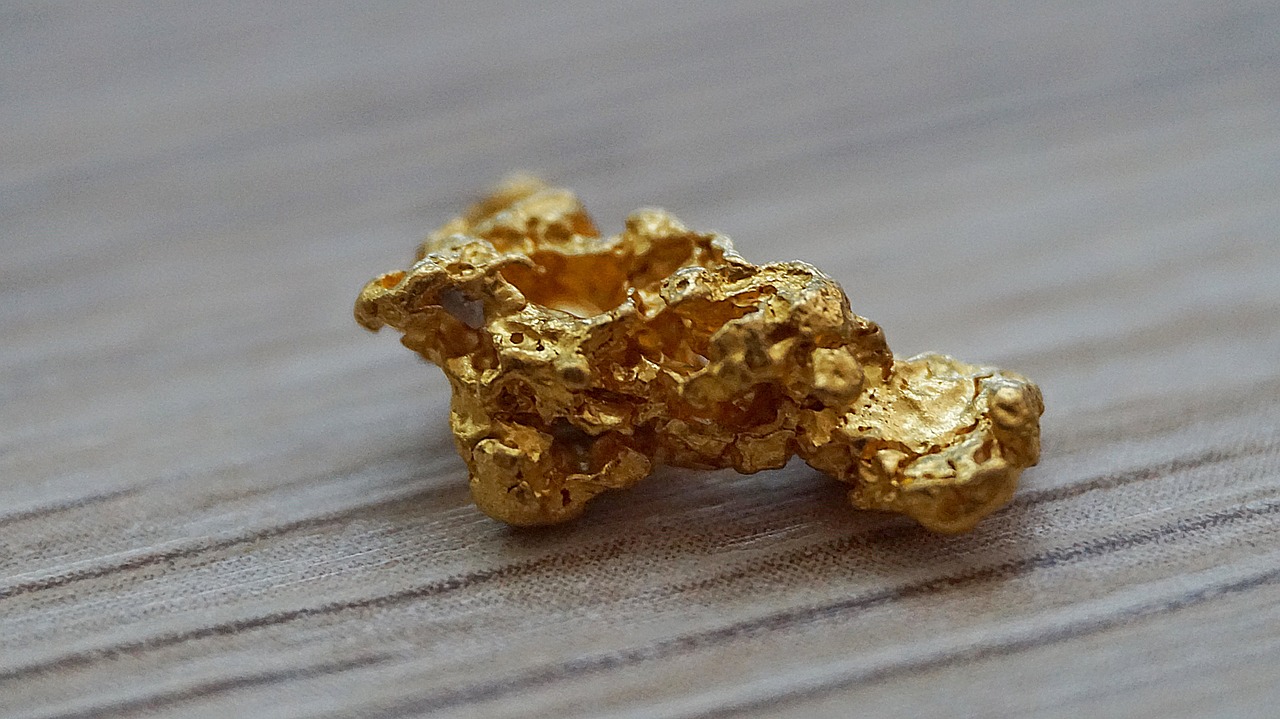
Gold is very heavy. If you have a piece of rock that seems heavy when compared to its volume and there is evidence of a golden yellow color within, you may have gold. Gold is very soft and can be scratched easily. Using your fingernail or a hard implement, you can sometimes dent the surface.
Brass shines as fair to the ignorant as gold to the goldsmiths.
- Elizabeth 1
Field Tests to Determine Mineral Type
Gold ore combines with few elements. Because of this, it is found in nature in pure form and, to a limited extent, in gold ores. The gold ores that exist produce a relatively small percentage of all discovered gold. Nagyagite, calaverite, sylvanite, and krennerite are four examples of low-yield gold ore. Since gold forms few compounds, gold ore is relatively rare. Learn about luster, streak, hardness, and cleavage, all of which are physical characteristics that may help identify gold ore prospects.

Mohs Hardness Testing for Minerals
Let's get down to the nitty-gritty—why learn about luster, streak, hardness, and cleavage? If you are reading this article, you more than likely have an interest in learning about and/or finding gold. I do too.
So if you stumble upon an abandoned mine or start to take a miner's pick to a piece of rock with quartz streaks in it, how do you know (or have good reason to believe) the ore you have attained is a classic gold ore? You can use Mohs tests in the field to determine the ore characteristics and see if that jives with what the Mohs test has to say about gold ore. Though rather rare, gold does appear in forms other than pure nugget or string. It can be mixed in with the minerals calaverite, krennerite, and silverite.
On the Mohs scale, calaverite has a hardness of 2.5 to 3. Cleavage is absent. Its luster is bright metallic. Its color is silver white to brass-yellow, and its streak is yellow gray. Using various tools and minerals of known hardness, one can perform a scratch test. The first object or mineral to scratch the ore gives an approximate value for hardness.
Scratching repeatedly over a white glazed tile with a pocketknife gives a measure of powder. When smeared, if it is calaverite, the streak should be yellow gray. In this manner, many tests can be performed that will give the prospector a better idea of what ore he has discovered.
Carrying a handbook to help you identify minerals is also a good idea. The Handbook of Rocks, Minerals, & Gemstones by Walter Schumann, Dr. and R. Bradshaw is reasonably priced and thorough.

Useful Information About Gold Prospecting
- There is a lot to know when starting the hobby of gold prospecting.
- The prospective gold prospector needs to understand the tools involved in gold prospecting.
- One needs to understand how gold placer (alluvial gold) winds up where it is.
- One needs to know about hard-rock mining.
- One needs to figure out where to go on a claim for the first time.
- One needs to know where gold has been found historically.
- One needs to understand his or her state laws and the federal mining laws regarding an individual recreational prospector.
- State geologic survey sites are a good source of information about gold mining. The U.S. Geologic Survey has maps of large gold mining areas.

Testing for Gold Using Streak Plates
Streak plates are glazed white tiles upon which portions of mineral can be scratched off to produce a line of powder. The powdered mineral can then be seen clearly, and the color of its streak can be observed. The streak contrasts with the white quite vividly.
Rubbing a piece of gold across white unglazed porcelain tile will not leave a dark streak. If the streak is black, it is not gold. Such a steak could indicate pyrite. Gold will reveal itself as a golden yellow.

MagnetismIf you know you have a piece of gold, hold a magnet near it. If the piece is attracted, there are other metals causing the attraction. Pure gold is not magnetic. If you have a sample you believe is gold, and it is not magnetic, it proves nothing. Copper, brass, and stainless steel are not magnetic, for example.

Hand Lenses
I have found hand lenses for as little as $5. These loupes are 30 power, while some even have LED lights in them. They are lightweight and small, fitting comfortably in the pocket. Many are made with silver-colored metal frames, but reflection of light off of these may interfere with identification. Others are black and made of plastic.

Gold Extraction
Since all (as far as I know) extraction methods involve chemicals that can produce noxious and deadly gas vapors, there are articles that lay out the procedures. Simply google "gold extraction." Remember to always wear a mask/ventilator if you wish to separate gold from ore (in its pure form) chemically. The building should also have good ventilation. Deferring to professionals when using chemicals may be the right decision.
Of Interest to Gold Prospectors
Finding gold may not be as simple as seeing a gold stringer in a quartz outcropping. Sometimes gold is mixed in ore with manganese. Other times, it can be found in reddish rock, occurring due to iron oxide (rust), with lines of quartz. Another form of volcanic rock, basalt, can contain gold and quartz and varies from a dark black to grey. Yet other times, it is in the form of placer, flakes that have washed down a mountain in some kind of water pathway. To increase your yield, you really need to get some basic equipment.
Sources
Hobart M. King, PHD, RPG, The Most Important Gold Prospecting Tools, 2005 - -2018, Geoscience News and Information.
Harold Kirkemo, USGS, 2016, Prospecting for Gold in the United States.
Jay Motes, In What Rock Formations Can Gold Be Found?, April 24, 2017.
Staff, How To Test Gold, 2017 Prospecting.com.
Staff, Gold Prospecting for Beginners, 2017.


Comments